# He's in speech therapy for English whilst learning Spanish on an app, and both are improving
> Yes, a child in speech therapy can still build a second language. Emiliano's parents aren't fluent in Spanish either, and he's improving in both.
Published: 2026-08-14
Canonical: https://studycat.com/blog/he-s-in-speech-therapy-for-english-whilst-learning-spanish-on-an-app-and-both-are-improving/
---
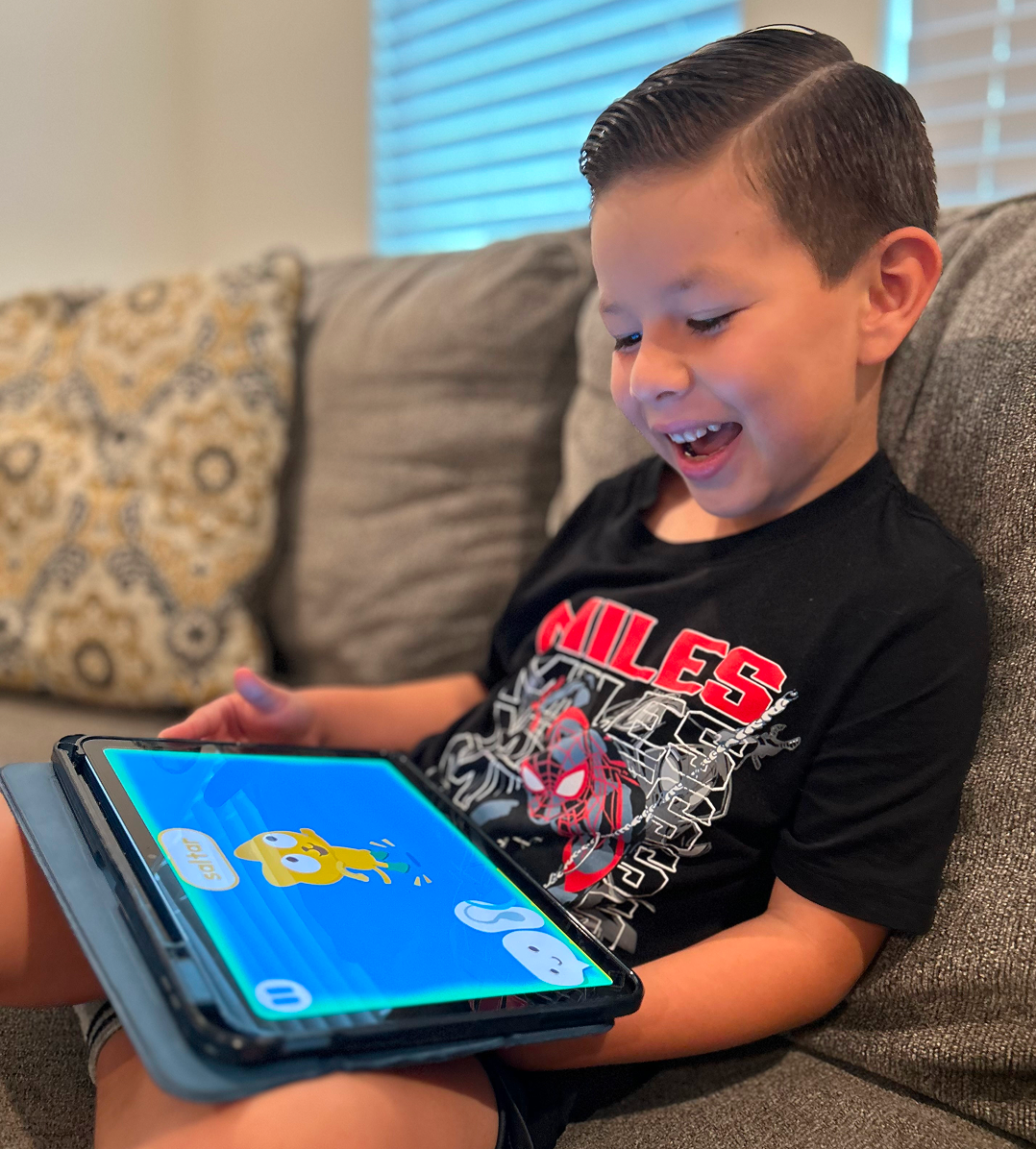
A child can be in speech therapy for their first language and still build real skills in a second, and that's what Emiliano's family is proof of. Sonia lives in the US with her husband and their 6-year-old son, Emiliano. Neither she nor her husband speaks Spanish fluently, but Emiliano is learning it, at school, at home, and in 5-minute stretches on the morning school run. There's no dedicated study time, no set schedule. She just fits it into the day where it lands.
## **Key takeaways**
* When parents aren't fluent in the language their child is learning, consistent low-pressure practice still makes a real difference
* How much a child practices matters more than when they start, which means short daily sessions genuinely add up
* For children who hold back out of fear of getting it wrong, removing performance pressure can have a big impact
* Hearing your own voice played back is surprisingly powerful for building pronunciation confidence and memory in a second language
Emiliano has been using Studycat Spanish for about a year. At school, he's in a dual-language program where instruction alternates each week between Spanish and English, switching which language gets the morning and which gets the afternoon. He also goes to speech therapy; he's been going since he was two, when his parents noticed he was slow to get his first words out. English came first for him, and Spanish is what he's building alongside it.
He's confident where he feels solid. "He's a numbers person," Sonia says. Math, no problem. With Spanish it's different. "He tends to be more shy about it, because he doesn't want to get it wrong." That's really what shapes how they approach his learning: not pushing, not making it a test, just keeping the door open.
## **You don't need to be fluent to raise a bilingual child**
Spanish has history in this family. Emiliano's grandparents on both sides are fluent, but they grew up at a time when US schools pushed English-only, and that fluency never got passed down. "They just taught me and my husband, like, both English as we were growing up."
So now here's Sonia, trying to bring it back. "We're kind of trying to bring that back around while he's learning Spanish, and we're still learning Spanish." She encourages the grandparents to speak Spanish with Emiliano when they can, since they have the fluency she and her husband are still working toward.
More parents are in this position than you might think, learning alongside their child rather than leading from fluency. [What bilingualism looks like varies a lot from family to family](https://studycat.com/blog/what-it-really-means-to-be-bilingual/), and Emiliano's path (building English first, Spanish second) is actually one of the most common routes.
The research is encouraging too. [A study in *Frontiers in Psychology*](https://www.frontiersin.org/journals/psychology/articles/10.3389/fpsyg.2023.1150159/full) found that children who regularly switch between two languages in educational settings show stronger inhibitory control than their monolingual peers, the ability to focus, manage distractions, and stay on task. His school environment is already working hard. Sonia's job is to keep Spanish alive in the gaps.
## **Short daily sessions work**
One thing Sonia is clear on: she doesn't want this to feel like school. "I don't want to put it as, like, okay, now it's time for Studycat. I don't want to make it, like, a homework. I kind of want to keep it fun and light for him to assist in his learning with Spanish."
So Emiliano uses the app during car rides, sometimes for a short stretch in the evenings, whatever fits. And the research backs that up. [A study in the *International Journal of Bilingualism*](https://journals.sagepub.com/doi/10.1177/1367006917722418) found that total exposure can matter more than when learning starts. A few minutes a day, practiced consistently, compounds.
Inside the app, he gravitates towards the Topics zone, picking which learning games he wants rather than following the set adventure path. Sonia noticed the difference when she stopped nudging him toward the structured route. "I think when he goes into the app and he's choosing the games he wants to play, it keeps up the engagement, because he's... in power of his adventure." She's the kind of person who follows a plan from start to finish, and she'd prefer he work through every activity in sequence. But she's learned to let it go, because what matters more is that he shows up.
## **Practice in one language builds confidence in another**
His favorite thing in the app is hearing his own voice played back to him. "He really loves it when he's prompted to say the word, and then it's repeated back to him, so he's hearing it in his own voice, and how he's pronouncing the words." That's VoicePlay™, Studycat's speaking practice feature in Studycat Spanish, built on the idea that saying a word out loud creates a stronger memory of it than just hearing or reading it.
What Sonia didn't expect was the crossover into his speech therapy. "I think using apps like Studycat Spanish that have helped him develop his language skills, even in another language, is helping him tremendously to gain confidence to learn how to speak any type of words, whether in English or in Spanish. Practicing using those muscles in his mouth and tongue." It makes sense when you think about it. Speaking is speaking, regardless of which language you're doing it in.
## **What happens when you take away the timer**
Studycat removed the timer feature from its learning games after parents flagged it was causing stress in their kids. Sonia felt the change almost immediately. "He's a lot more chill. He's a lot more, like, relaxed without it."
For a child who already pulls back in Spanish because he's afraid of getting it wrong, that shift matters more than it might sound. When a kid is anxious, they stop trying things — and for language learning especially, that willingness to have a go, to say the word even when you're not sure, is everything.
The characters help too. "I love it," she says, "they're always like, 'perfecto,' or... you know? The instant feedback of him getting a thing right on the app, and they're saying, you know, 'bravo'... it makes him feel good when he knows he's doing good."
## **Keep the language in their life, and let consistency do the work**
When friends ask, she doesn't overthink the pitch. "It's a language learning app that is filled with games to help you memorize certain words... there's also features in it where you can speak the words, and actually practice those words getting out. You're getting that instant feedback, saying that, you know, you're on the right track and you're doing well with it."
She's not chasing fluency for its own sake. She just wants Spanish to stay in Emiliano's life long enough that it starts to feel like his. The language his grandparents carried, that got lost somewhere in her generation, slowly finding its way back.
"I'm very happy with Studycat so far, and I can't wait to see what new things you guys come out with."
## **Try it at home:**
On your next car journey, call out a Spanish word your child has been practicing and ask them to say it back. It doesn't need to be a lesson. One word, in their own voice, counts.
[btn: "Explore Studycat Spanish"](https://studycat.com/products/spanish/)
## **Frequently Asked Questions**
### **Can my child learn Spanish if neither parent is fluent?**
Yes. Dual-language school programs, consistent app-based practice, and input from extended family members are all meaningful sources of Spanish exposure. Research shows that the total amount of time a child spends engaging with a language matters more than who is doing the teaching. Studycat Spanish is designed for independent, guided learning so children can build real skills even when their parents are learning alongside them.
### **Does Studycat Spanish work well alongside a dual-language school program?**
Studycat Spanish complements classroom learning by giving children a low-pressure space to reinforce vocabulary and speaking practice outside of school. Even short daily sessions during car rides or downtime are effective. For guidance on how much practice time works best, [Studycat's article on optimal study time for children](https://help.studycat.com/hc/en-us/articles/34572715795993-Optimal-study-time-for-children) is a useful starting point.
### **What age is Studycat Spanish designed for?**
Studycat Spanish is designed for children aged 2–8. For more on what to expect at different stages, [this overview of suitable ages for Studycat](https://help.studycat.com/hc/en-us/articles/34568231183769-Suitable-ages-for-Studycat) covers what parents need to know.
## **Scientific References & Further Reading**
* *Gosselin, L., & Sabourin, L. (2023). Language athletes: Dual-language code-switchers exhibit inhibitory control advantages. Frontiers in Psychology, 14. https://doi.org/10.3389/fpsyg.2023.1150159*
* *Thordardottir, E. (2019). Amount trumps timing in bilingual vocabulary acquisition: Effects of input in simultaneous and sequential school-age bilinguals. International Journal of Bilingualism, 23(1), 236–255. https://doi.org/10.1177/1367006917722418*
## **About Studycat**
Studycat creates five language learning apps — Studycat English, Spanish, French, German, and Chinese — designed to help children develop language skills through research-backed interactive learning games. With over 50,000 five-star reviews, parents trust our real learning outcomes on iOS and Android devices.