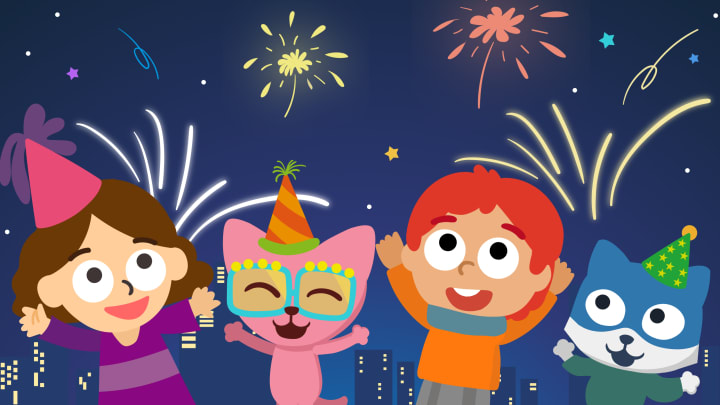
Fireworks crackle, clocks tick louder than ever, and everyone gets ready to shout “Happy New Year!” at just the right moment. New Year’s Eve—celebrated on 31 December—is more than a night of parties and sparkling lights.
For young English learners (and the grown-ups guiding them), it’s a golden opportunity to explore fun vocabulary about time, numbers, celebrations, and fresh beginnings.
Whether you’re counting down to midnight, making resolutions, or dancing in confetti, every New Year’s Eve moment is packed with playful learning.
So let’s jump into the celebration and discover how English words can make this holiday even brighter!
What is New Year’s Eve?
New Year’s Eve is the final day of the Gregorian calendar year. Families and friends gather to “ring out the old, ring in the new,” sharing food, music, and a dramatic count-down to midnight when one year ends and another begins.
In many places, the fun rolls straight into New Year’s Day on 1 January—often with sleepy smiles and confetti stuck to the sofa.
Key dates to mark
| Year | Day of the week | Date |
|---|---|---|
| 2025 | Wednesday | 31 December 2025 |
| 2026 | Thursday | 31 December 2026 |
| 2027 | Friday | 31 December 2027 |
| 2028 | Sunday | 31 December 2028 |
| 2029 | Monday | 31 December 2029 |
The history of New Year’s Eve
-
Ancient beginnings – Babylonians held an Akitu new-year festival more than 4 000 years ago.
-
Roman reset – Julius Caesar’s Julian calendar (46 BCE) placed the civic new year on 1 January to honour the two-faced god Janus, who looks backward and forward.
-
Gregorian tweak – Pope Gregory XIII’s 1582 reform kept 1 January but fine-tuned leap years; most of the world now follows this calendar.
-
Mass-media midnights – Public clocks, electric lights, radio, and television turned local celebrations into global spectacles like New York’s Times Square ball drop (first held in 1907).
Traditions that make the night sparkle
The countdown
Counting aloud from ten to zero lets learners practise numbers—and suspense! A loud “Happy New Year!” sparks future-tense sentences about hopes and goals.
Fireworks and noisemakers
Early fireworks were meant to scare away evil spirits; today they simply light the sky while pots, pans, and party horns teach onomatopoeia (bang, pop, fizz).
Lucky foods
-
Spain & Latin America: twelve grapes—one for each clock chime—promise good luck.
-
USA South: black-eyed peas and collard greens symbolise coins and cash.
-
Italy: lentils represent prosperity.
-
East Asia: long noodles suggest a long life.
Talking about flavours introduces adjectives like tangy, chewy, and savory.
Family fun
Photo booths, living-room “camp-outs,” and kindness projects wrap generosity around the big countdown, letting kids practise verbs (plan, share, giggle).
New Year’s Eve around the world
| Place | Unique twist | Language-learning hook |
|---|---|---|
| Japan (Ōmisoka) | Temple bells ring 108 times to cleanse worldly desires. | Practise large numbers and verbs ring and echo. |
| Spain | Eat 12 “lucky grapes” with each midnight chime. | Count aloud and use ordinal numbers. |
| Scotland (Hogmanay) | First-footing: the first visitor after midnight brings gifts like coal or shortbread. | Role-play greetings and polite offers. |
| Philippines | Round objects—polka-dot clothes, circular fruit—symbolise prosperity. | Identify shapes: round, circle, sphere. |
| Brazil | Wear bright colours and toss flowers into the sea for blessings from Iemanjá. | Describe colours and water verbs float and splash. |
Countdown-friendly English activities
-
Balloon-pop schedule
Hide mini tasks inside balloons marked 6 p.m. – 11 p.m. Pop one each hour—sing a song, list five adjectives, act out a verb. -
Edible clock
Place twelve cookie “numbers” around a plate. Each hour, eat the correct cookie and announce the time: “It’s nine o’clock!” -
Time-capsule chain
Every learner writes one English sentence about a 2025 memory, seals it in an envelope, and labels it “Open next New Year’s Eve.” -
Resolution poster
Divide a sheet into I will learn, I will try, I will share. Learners add drawings and future-tense sentences.
Step boldly into a bright new year
Before the fireworks fade, choose one mini mission:
-
Teach a new English word—perhaps resolution or firework—to someone at the party.
-
Share one spoken sentence of gratitude for the year just ending.
-
Plan a January kindness act, like donating books or cleaning a park.
Small sparks of language and kindness can glow long after midnight.
Learning that lasts beyond midnight
New Year’s Eve lasts a single night, but its excitement can fuel months of curiosity. Keep momentum by:
-
counting the first 100 days of the new year in English,
-
tracking daily weather adjectives (chilly, breezy, sunny),
-
writing a monthly progress note—like a mini time capsule—to “future you.”
With Studycat beside you, every clock chime becomes a chance to explore words, cultures, and big dreams.
Happy New Year’s Eve, and here’s to twelve months of laughter, learning, and playful Studycat adventures! 🎉
Try Studycat language learning apps available on iOS and Android.


