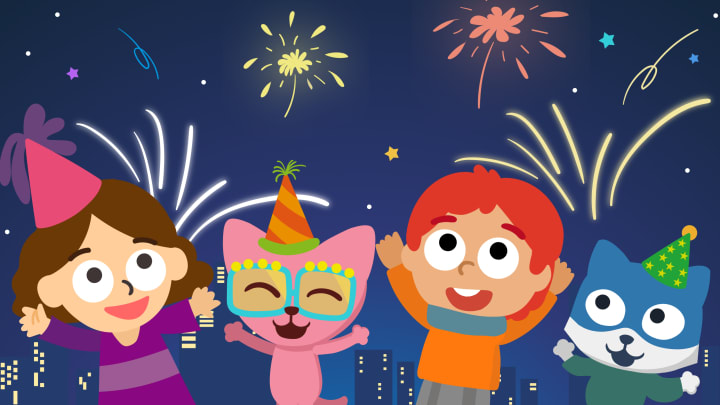
The last night of the year is full of excitement—flashing lights, cheering crowds, clinking glasses (of juice!), and countdowns that end in fireworks and hugs.
New Year’s Eve, celebrated on 31 December, marks the big moment when one year ends and a brand-new one begins.
For kids learning English, it’s the perfect time to explore festive words and phrases that pop, fizz, and sparkle—just like the night itself! From party hats and confetti to resolutions and midnight cheers, this holiday is packed with vocabulary that brings fun and learning together.
So grab your noisemakers and your brightest party hat—Studycat style—and get ready to learn all about the traditions, phrases, and playful language that make New Year’s Eve one of the most exciting nights of the year!
What is New Year’s Eve?
New Year’s Eve is the evening before New Year’s Day, the first day of the Gregorian calendar year. Families and friends gather to share food, watch fireworks, and count down to midnight together.
Many cities host public events—think New York’s glittering Times Square ball drop or London’s river-bank fireworks—while others stay cosy at home watching televised celebrations.
In some cultures, people write wishes for the coming year, ring bells to chase away bad luck, or feast on lucky foods like grapes or long noodles.
New Year’s Eve traditions around the world
-
United States – the ball drop: A glowing sphere descends a flagpole in Times Square as crowds chant the final ten seconds.
-
Spain – twelve grapes at midnight: One grape for each stroke of the clock promises good luck for every month.
-
Japan – “joya no kane” bell ringing: Buddhist temples chime 108 times to cleanse the old year’s worries.
-
Brazil – ocean offerings: People wear white and toss flowers into the sea for good fortune.
-
Scotland – first-footing: The first visitor after midnight brings gifts (often shortbread or coal) to ensure warmth and plenty.
These varied customs give kids a global view of how people welcome a fresh start and supply great conversation starters like “How do you celebrate where you live?”
Must-know New Year’s vocabulary and phrases
| Word / phrase | Kid-friendly meaning | Example sentence |
|---|---|---|
| countdown | counting backward to zero | Join the countdown from ten to midnight! |
| fireworks | colourful lights that explode in the sky | Red fireworks painted the night. |
| confetti | tiny paper pieces tossed in the air | Throw confetti at twelve o’clock. |
| noisemaker | toy that makes loud sounds | Blow your noisemaker when the clock strikes. |
| party hat | cone-shaped celebration hat | Put on a gold party hat for photos. |
| resolution | promise to do something new or better | My resolution is to read every day. |
| midnight | 12:00 a.m., start of a new day | We hugged at midnight exactly. |
| toast | raising glasses to wish good things | Dad led a toast to health and happiness. |
| Auld Lang Syne | traditional New Year song from Scotland | Everyone sang “Auld Lang Syne” together. |
| ball drop | famous Times Square countdown event | We watched the ball drop on TV. |
| celebration | fun event to mark a special time | The celebration lasted past midnight. |
| sparkle | shine with small bright flashes | Sparklers sparkle in the dark. |
| banner | decorative strip with words | The banner read “Happy New Year!” |
| cheer | shout happily | Kids cheered when the clock hit twelve. |
| festive | full of fun and colour | The living room looked festive with balloons. |
| calendar | chart that shows days and months | A new calendar starts tomorrow. |
| happy new year! | greeting used at midnight | We yelled “Happy New Year!” together. |
| goodbye, old year! | playful phrase | Say “Goodbye, old year!” before the toast. |
| ring in the new year | welcome the new year | Let’s ring in the new year with music. |
| out with the old, in with the new | saying about fresh starts | Out with the old, in with the new clothes! |
Tip: Pronounce Auld Lang Syne like “old lang zyne.”
Fun practice ideas for little revelers
DIY countdown chain
Cut twelve paper strips and write one vocabulary word on each. Loop them into a chain. Every hour on New Year’s Eve, tear off a link, read the word aloud, and use it in a quick sentence: “Fireworks light up the sky.”
Resolution fortune wheel
Draw a circle, divide it into six sections, and label each with verbs: read, exercise, help, learn, share, create. Spin a pencil in the centre to pick a “resolution action,” then finish the sentence: “This year I will read more adventure stories.”
Confetti spelling race
Write target words (e.g., midnight, sparkle, calendar) on index cards. Scatter paper confetti on a table. When you call a word, learners race to find the right letters hidden under confetti pieces and spell the word aloud.
Parade of phrases
Give each child a party hat and have them parade around the room. When the leader shouts “ring in the new year!” everyone freezes and pairs up to practise short dialogues:
A: “Happy New Year!”
B: “Thank you—let’s toast to new adventures!”
Balloon pop quiz
Slip vocabulary questions into balloons before inflating: “What is a resolution?” “Make a sentence with confetti.” As midnight approaches, pop balloons one by one and answer together.
Make next year your best learning year yet!
New Year’s Eve is all about fresh beginnings—so why not set a language resolution? Pick three words from today’s list and promise to use them in the first week of January.
Whether you’re shouting a joyful countdown, making a sparkling toast, or writing your very first resolution, every new phrase pushes your English one step forward. May the new year bring endless curiosity, big smiles, and lots of learning fun. Try Studycat English apps today, available on iOS and Android.
Happy New Year from Studycat!


