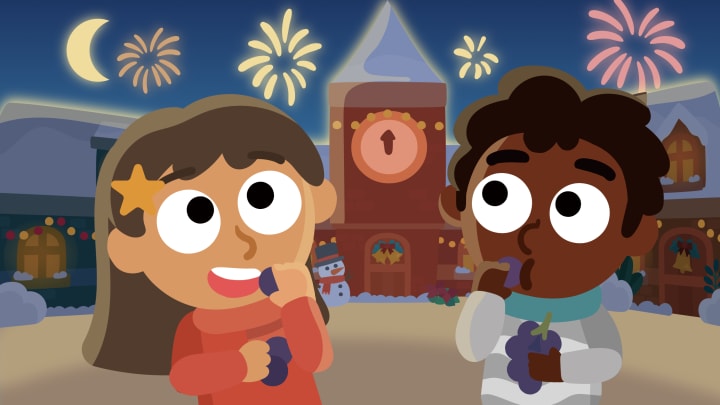
Happy New Year, language adventurers and amazing parents! Get ready to celebrate a super exciting holiday, New Year’s, or as we say in Spanish, Año Nuevo!
This article is packed with fun Spanish words and phrases about New Year’s traditions, joyful celebrations, and how people welcome a fresh start around the world.
Let’s make learning Spanish a fantastic part of your new year!
What is New Year’s all about?
New Year’s is a holiday celebrated all over the world, marking the end of one year and the beginning of another! It’s a time for looking back at all the fun and learning from the past year, and making exciting plans and wishes for the year ahead. People often gather with friends and family, enjoy special food, and watch fireworks to celebrate the new beginning. It’s a time of hope, happiness, and fresh starts!
When is New Year’s?
- New Year’s Eve (Nochevieja): December 31st (the last day of the year!)
- New Year’s Day (Día de Año Nuevo): January 1st (the first day of the new year!)
Here are the dates for New Year’s for the next few years:
- 2025:
- New Year’s Eve: Wednesday, December 31st
- New Year’s Day: Thursday, January 1st
- 2026:
- New Year’s Eve: Thursday, December 31st
- New Year’s Day: Friday, January 1st
- 2027:
- New Year’s Eve: Friday, December 31st
- New Year’s Day: Saturday, January 1st
- 2028:
- New Year’s Eve: Sunday, December 31st
- New Year’s Day: Monday, January 1st
A look back in time: the history of New Year’s celebrations
Celebrating the New Year is one of the oldest traditions in the world! Long, long ago, even ancient civilizations celebrated new beginnings. Different cultures had different ways of deciding when a new year started, often linked to harvests or the seasons. For example, some celebrated in spring, when new plants grew, or in autumn, after crops were gathered.
The tradition of celebrating on January 1st actually started with the Romans, many centuries ago. They dedicated this day to Janus, the Roman god of beginnings and transitions, who had two faces – one looking to the past and one to the future. Over time, this date became widely adopted around the world as the official start of the new year.
So, when you celebrate New Year’s, you’re part of a very old, global tradition!
Joyful traditions: how people welcome the New Year!
New Year’s is full of fun traditions! Let’s learn some key Spanish words and phrases related to these exciting celebrations:
- Counting down to midnight: The most exciting part of New Year’s Eve is the cuenta atrás (countdown) to midnight! Everyone watches the clock as the seconds tick down to the medianoche (midnight). When it hits zero, it’s ¡Feliz Año Nuevo!
- Spanish words to remember:
- cuenta atrás (countdown)
- medianoche (midnight)
- reloj (clock)
- Useful phrases:
- ¡Diez, nueve, ocho…! (Ten, nine, eight…!)
- ¡Feliz Año Nuevo! (Happy New Year!)
- ¡Feliz Nochevieja! (Happy New Year’s Eve!)
- Spanish words to remember:
- Eating twelve grapes: In Spain and many Latin American countries, a super unique tradition is eating doce uvas (twelve grapes) at midnight! You try to eat one grape for each chime of the clock at midnight. Each grape represents good luck for each of the doce meses (twelve months) of the new year. It’s a fun, fast, and sometimes very funny challenge!
- Spanish words to remember:
- doce uvas (twelve grapes)
- suerte (luck)
- meses (months)
- Useful phrases:
- Come una uva. (Eat a grape.)
- ¡Buena suerte! (Good luck!)
- Una uva por cada mes. (One grape for each month.)
- Spanish words to remember:
- Family gatherings and special meals: New Year’s is a time for reuniones familiares (family gatherings) and enjoying delicious cena (dinner) on New Year’s Eve. People often have special comida (food) and lots of laughter.
- Spanish words to remember:
- reuniones familiares (family gatherings)
- cena (dinner)
- comida (food)
- familia (family)
- brindar (to toast, to make a toast)
- champaña / cava (champagne / Cava, a Spanish sparkling wine - for adults!)
- Useful phrases:
- ¡Brindemos por el Año Nuevo! (Let’s toast to the New Year!)
- La cena es deliciosa. (Dinner is delicious.)
- Spanish words to remember:
- Fireworks and celebrations: As the clock strikes midnight, cities light up with spectacular fuegos artificiales (fireworks)! Many people go to parties, dance, and celebrate with amigos (friends) and familia.
- Spanish words to remember:
- fuegos artificiales (fireworks)
- fiesta (party)
- bailar (to dance)
- amigos (friends)
- Useful phrases:
- ¡Mira los fuegos artificiales! (Look at the fireworks!)
- Vamos a la fiesta. (Let’s go to the party.)
- Spanish words to remember:
New Year’s fun: celebrations around the Spanish-speaking world!
New Year’s traditions are extra special in Spanish-speaking countries!
- Colombia: “el año viejo” dolls and suitcases: In Colombia and other Latin American countries, families often make or buy muñecos de Año Viejo (old year dolls or effigies) filled with old clothes, paper, and sometimes fireworks! At midnight on New Year’s Eve, these dolls are burned, symbolizing leaving behind the old year’s troubles and bad luck. Also, some people run around the block with an empty maleta (suitcase) to bring travel in the new year!
- Ecuador: masks and lists of wishes: Similar to Colombia, Ecuador also burns effigies. But many people also wear masks representing popular characters or politicians. Before midnight, people write down their wishes or things they want to improve in the new year on a lista de deseos (wish list).
- Puerto Rico: throwing water and cleaning: In Puerto Rico, some people throw buckets of agua (water) out their windows at midnight to cleanse their homes and wash away bad spirits from the old year. Many also do a thorough limpieza (cleaning) of their homes before New Year’s Eve to start fresh.
- Chile: lentils and lucky money: In Chile, eating a spoonful of lentejas (lentils) at midnight is believed to bring good fortune and prosperity for the new year. Also, some people place a billete (banknote) in their shoe to attract money in the coming year!
These wonderful traditions show how each culture brings its own special flavor to welcoming a new year, often focusing on good luck, prosperity, and leaving the past behind.
Make your New Year’s extra special with Spanish words!
Ready to make your New Year’s celebration even more fun with some Spanish? Here are some simple ways to use the words and phrases you’ve learned!
- Practice the countdown: As you wait for midnight, count down in Spanish! “¡Diez, nueve, ocho… uno!” (Ten, nine, eight… one!) Then shout, “¡Feliz Año Nuevo!”
- Share your resolutions: Talk about your resoluciones de Año Nuevo (New Year’s resolutions). Maybe, “Quiero aprender más español.” (I want to learn more Spanish.)
- Toast in Spanish: Raise a glass of juice or sparkling cider and say, “¡Brindemos por el Año Nuevo!” (Let’s toast to the New Year!)
- Talk about luck: If you eat grapes or lentils, you can say, “Para la buena suerte.” (For good luck.) or “¡Mucha suerte!” (Lots of luck!)
- Describe the fireworks: Point to the fuegos artificiales and say, “¡Qué bonitos!” (How beautiful!) or “¡Me encantan!” (I love them!).
Keep the language adventure glowing!
Learning a new language is like starting a brand new year – full of exciting possibilities and growth!
Every new word you learn, like Año Nuevo or suerte, opens up new ways to explore the world and connect with amazing people. Using Spanish words during fun holidays like New Year’s makes learning feel like a grand celebration.
You’re doing an amazing job on your language learning journey. Keep playing, keep exploring, and keep those curious minds active!
Ready for more language fun and games to kickstart your learning in the new year? Hop over to Studycat Spanish app and let the language learning adventure continue!
¡Feliz Año Nuevo y Próspero Año Nuevo! (Happy New Year and Prosperous New Year!)


