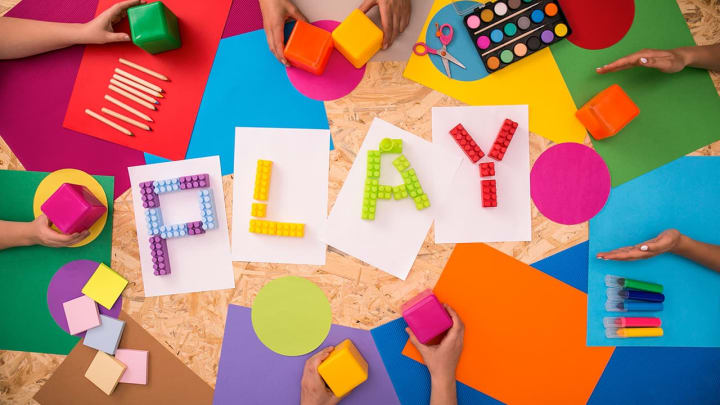
For a long time, play and learning were treated as two ends of a seesaw. More of one meant less of the other. Children who played were not doing academics. Children doing academics were not playing. This framing has been so persistent in parenting and school culture, that questioning it still feels slightly radical.
But a growing body of research is making the case decisively: for children in the 2–8 age range, play is not a break from learning. It can be the primary mechanism through which learning happens. And the distinction matters enormously for how parents think about what their child is doing all day.
Key takeaways
- A 2026 scoping review synthesizing 51 studies across four continents found that play-based learning consistently supports cognitive, literacy, and socio-emotional outcomes in children aged 4–6
- The Institute of Education Sciences identifies play-based learning as one of the most effective pedagogical approaches for young children, with guided play outperforming direct instruction for children under eight
- Play is not simply entertainment. It is the cognitive workout that builds executive function, language, and problem-solving capacity
- Summer is one of the best opportunities to build language skills through play, not just maintain them
- Short, consistent, play-based language sessions produce stronger retention than longer, occasional formal practice
What researchers mean by “play-based learning”
When developmental scientists talk about play-based learning, they are not describing a child left alone with a pile of blocks. They are describing something more specific: structured play environments where children have agency over how they explore, but where the environment itself has been designed to produce learning.
The 2026 scoping review published in the Early Childhood Education Journal synthesized findings from 51 peer-reviewed studies conducted across four continents, covering pre-primary learners aged 4–6. The review identified consistent evidence across cognitive, literacy, and socio-emotional domains. Play-based learning produced stronger results not because it made children happy (though it often did), but because it required active participation, creative problem-solving, and repeated engagement with material in new contexts.
This is a meaningful distinction. A child passively watching educational content is not doing what researchers mean by play-based learning. A child interacting with a challenge that responds to their input, returning to it multiple times, and encountering the same concepts in varied forms — that is.
A 2022 meta-analysis from Cambridge University’s PEDAL Research Centre, reviewing studies of children aged 1–8, found that guided play outperformed direct instruction on early maths and task switching (particularly valuable for children learning to move between two languages). The finding is specific: it is not that all play is equally valuable, but that play which involves structure, responsiveness, and intentional design consistently outperforms passive or rote approaches.
Why summer is not a threat to learning
One of the least-discussed implications of play-based learning research is what it means for summer. Many parents approach the summer months with a mix of relief and mild anxiety: relief that the school schedule is over, anxiety about whether their child will fall behind. The research offers a different frame.
Summer is the season with the most available time for play-based learning to work as it was designed to. School terms are full. Children are tired, context-switching constantly, and fitting learning into narrow windows. Summer strips that pressure away. A child who sits down with a learning game or fun activity on a Tuesday afternoon in July is doing so in a more relaxed, more receptive state than the same child in October.
The concern about summer slide is real, andNWEA’s ongoing research makes clear that academic skills are especially vulnerable to extended gaps in practice. But the solution is not to recreate school at home. It is to replace passive summer screen time with purposeful daily practice that feels like play. The distinction between those two things is precisely what the research points to.
What play-based learning looks like for language
Language is one of the areas where the evidence for play-based approaches is most robust, and also where parents often underestimate what their child is doing when they appear to be “just playing.”
For a young child learning a second language, what matters is not how long they sit with a worksheet but how many times they encounter a word in different contexts, how often they are asked to produce it rather than just receive it, and whether the experience feels low-stakes enough to encourage repetition. These are structural features of good play-based language design.
A 2024 meta-analysis in Frontiers in Psychology examining game-based learning in children aged 3–8 found moderate to large effects on cognitive development, motivation and sustained engagement compared to traditional instruction. The mechanism matters: a child who wants to return to a learning activity tomorrow is building vocabulary more effectively than a child who has to be persuaded back.
Studycat’s language learning games for English, Spanish, French, German, and Chinese (available on iOS and Android devices) are designed around exactly these principles. Each session follows the same four-step structure that language researchers consistently identify: hear it, learn it, say it, use it. Vocabulary returns in new contexts across sessions rather than being drilled in a single format. Children can navigate the learning games independently without adult direction, a deliberate design choice that supports the kind of intrinsically motivated practice that produces durable learning.
Three things parents can do right now
The research on play-based learning translates into practical shifts that are easy to implement.
Keep sessions short and regular.
The spacing effect (spreading practice across time rather than a long single session) applies directly to language learning for young children. Ten minutes every day outperforms an hour once a week. Summer is the ideal time to establish this habit before school-term demands compete.
Choose formats that require something back.
The most useful signal when evaluating any learning activity is whether the child is required to produce a response or action, not just receive input. A learning game that waits for the child to answer is doing more cognitive work than a video that plays uninterrupted. This is the core distinction between passive and purposeful practice.
Let curiosity lead.
One of the quieter findings in the play-based learning literature is that intrinsic motivation is not just a nice-to-have. It is a mechanism. A child genuinely absorbed in a learning game is building the same attentional muscles as a child completing a structured exercise, but with significantly less resistance and significantly more likelihood of returning the next day.
Try it at home:
Pick a consistent daily slot (after lunch, before dinner, or first thing in the morning) and open a Studycat learning game without instructions. Watch what your child does. If they find their way in and stay engaged, the design is working. The consistency of the slot matters more than the duration. Start sustainable and build from there.
Read the Studycat methodologyFrequently asked questions
How is a learning game different from just letting my child play?
The distinction is between unstructured play and structured play environments. In unstructured play a child has full agency but no learning goal is built in. In a structured play environment the child still leads and follows their curiosity, but the design shapes what they encounter. A learning game that presents vocabulary, waits for a response, and returns the same words in new contexts is building the repeated, varied exposure that language retention depends on.
Does play-based learning work as well as more formal instruction for young children?
For children under eight, the research consistently finds it works better. When children have agency over how they explore, but the environment is designed to produce learning, they engage more deeply and retain more. The key distinction isn’t play versus work. It’s whether the activity asks something real of the child: a response, a choice, a challenge. That active quality is what produces durable outcomes.
How much time should my child spend on play-based language learning each day?
Less than most parents assume, and more regularly than most manage. Short sessions returned to consistently across multiple days produce much stronger retention than longer sessions done occasionally. Ten to twenty minutes of engaged, responsive play-based learning each day is doing more cognitive work than an hour once a week. For Studycat’s guidance on session length and frequency, see optimal study time for children in the Help Centre.
Scientific References & Further Reading
- Mohammed, A. H., Nigussie, B., Schellens, T., & Rotsaert, T. (2026). Play-based learning in early childhood education: a scoping review. Early Childhood Education Journal. https://doi.org/10.1007/s10643-026-02127-6
- Alotaibi, M. S. (2024). Game-based learning in early childhood education: a systematic review and meta-analysis. Frontiers in Psychology, 15, 1307881. https://pmc.ncbi.nlm.nih.gov/articles/PMC11018941/
- Skene, K., O’Farrelly, C. M., Byrne, E. M., Kirby, N., Stevens, E. C., & Ramchandani, P. G. (2022). Can guidance during play enhance children’s learning and development in educational contexts? A systematic review and meta-analysis. Child Development, 93(4), 1162–1180. https://www.ncbi.nlm.nih.gov/pmc/articles/PMC9545698/
- Kuhfeld, M., & McEachin, A. (2026, April 23). Summer learning loss: what we know and what we’re learning. NWEA. https://www.nwea.org/blog/2026/summer-learning-loss-what-we-know-what-were-learning/
About Studycat
Studycat creates five language learning apps — Studycat English, Spanish, French, German, and Chinese — designed to help children develop language skills through research-backed interactive learning games. With over 50,000 five-star reviews, parents trust our real learning outcomes on iOS and Android devices.


