Spanish is consistently the most requested second language for children in the USA learning at home, and for good reason. It’s spoken across more than 20 countries, phonetically consistent enough for young learners to build real pronunciation skills, and increasingly valuable for children growing up in multilingual communities.
But many parents run into the same wall: they want to support their child’s Spanish, and they don’t speak it themselves. The good news is that input matters far more than who delivers it.
Start before they can read
One of the most common mistakes parents make is waiting until a child can read before introducing a second language. But early language learning happens through hearing and speaking, long before literacy arrives. Children aged 2-8 absorb sounds, rhythm, and vocabulary through repetition and play. Those early exposures build phonological foundations that support reading in both languages later on.
Research supports the value, consistent exposure. According to Thordardottir (2019), the amount of quality input matters more than the timing of when a child starts. You don’t need to begin at birth. But starting in the early years gives your child a meaningful foundation to build from.
What good exposure actually looks like
Effective Spanish learning for young children doesn’t require formal lessons. It looks like songs they can sing along with, learning games that ask them to respond out loud, short stories in Spanish, and activities that feel playful rather than instructional.
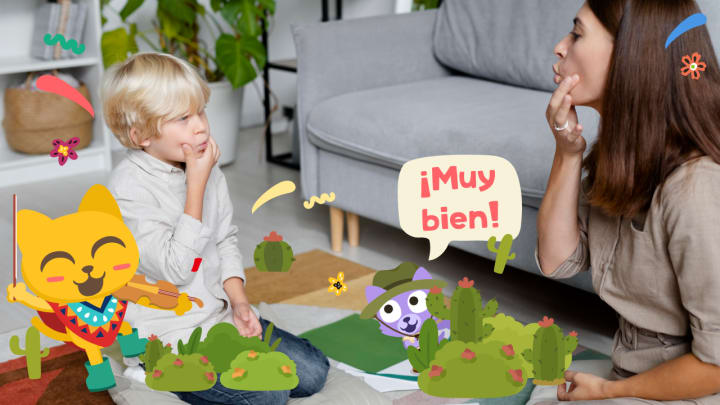
One principle makes a particular difference: children need to produce the language, not just hear it. The production effect (a well-established finding in cognitive psychology) shows that saying a word aloud creates a stronger memory trace than hearing or reading it passively (MacLeod et al., 2010). Activities that encourage a child to actually speak, even short phrases, build vocabulary more durably than passive listening alone.
Building a sustainable routine
Consistency beats intensity. 10-15 minutes of engaged Spanish learning each day builds more than a single long session once a week. Educational learning games on iOS and Android devices make it easy to incorporate Spanish into a daily routine without requiring a parent’s constant active involvement.
The most effective apps are ad-free, designed around young children’s attention spans, and built on genuine language learning methodology — not just vocabulary flashcards with animations. Look for apps where your child is actively speaking and responding, not just tapping through screens.
Try it at home:
Start with five Spanish words your child can use right away — colors, numbers, or animals they love. Introduce them through a song or a game, not a list, and ask your child to say each word out loud before moving on. That one step makes the words far more likely to stick.
Sources
- Thordardottir, E. (2019). Amount trumps timing in bilingual vocabulary acquisition: Effects of input in simultaneous and sequential school-age bilinguals. International Journal of Bilingualism, 23(1), 236–255. https://doi.org/10.1177/1367006917722418
- MacLeod, C. M., Gopie, N., Hourihan, K. L., Neary, K. R., & Ozubko, J. D. (2010). The production effect: Delineation of a phenomenon. Journal of Experimental Psychology: Learning, Memory, and Cognition, 36(3), 671–685. https://doi.org/10.1037/a0018785
About Studycat
Studycat creates five language learning apps — Studycat English, Spanish, French, German, and Chinese — designed to help children develop language skills through research-backed interactive learning games. With over 50,000 five-star reviews, parents trust our measurable learning outcomes on iOS and Android devices.


