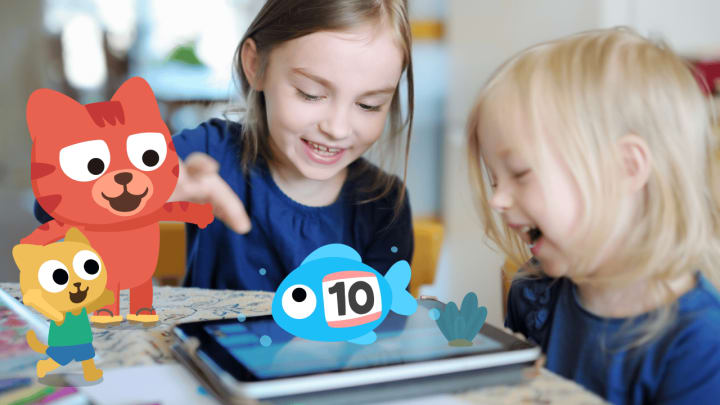
Last month, the U.S. Surgeon General’s Office recommended limiting children under 6 to less than 1 hour of screen use per day. It’s a headline that’s prompted a lot of anxiety, and a lot of questions from parents about what exactly counts. The advisory is well-intentioned, but it treats all screen use as a single category. Educational researchers don’t. The distinction between passive consumption and active, responsive learning is one of the most consistent findings in child development research, and understanding it changes how you think about the apps your child uses. Not all of them belong in the same conversation.
Key takeaways
- Educational researchers draw a firm line between passive and active technology use. Passive consumption engages very different cognitive systems than active, responsive use.
- The production effect, a well-established finding in cognitive psychology, shows that saying a word out loud creates a stronger memory trace than hearing or reading it passively.
- The Surgeon General’s advisory is right that not all screen use is equal. It stops short of helping parents identify which side of that line a given activity falls on.
- A few practical signals can tell you whether an app is doing something developmental or just filling time.
Not all screen use looks the same
Educational researchers have long differentiated between passive and active technology use in children. Passive consumption (scrolling, watching, absorbing content without interaction) offers little in the way of cognitive engagement. Active use, where a child is responding, choosing, producing language, or solving problems, engages entirely different cognitive systems.
Speaking activities sit in a category of their own. When a child says a word out loud, it’s fundamentally different from reading it or hearing it. Cognitive psychology researchers call this the production effect: vocalizing a word creates a distinctly stronger memory imprint than silent processing alone. Research by MacLeod et al. (2010) showed this across a series of controlled experiments. A child who says “rojo” isn’t just practicing pronunciation. They’re cementing that word more deeply into memory.
The Surgeon General’s advisory is right that not all uses of technology are equal. Where it stops short is in helping parents understand which side of that line a given activity falls on.
Why the environment around the learning matters too
It’s not only what a child does on a device that shapes the experience. It’s also what the app is designed to do with their attention.
A lot of children’s apps are built around engagement mechanics: streaks that create anxiety if missed, notification systems, ads that interrupt focus, feeds that reward scrolling. These features optimize for time on screen, not learning outcomes. They’re also the category of design the Surgeon General’s advisory is most directly concerned with.
Research on game-based learning helps explain why the design of the environment matters independently of the content. A systematic review and meta-analysis by Alotaibi (2024) found that well-designed game-based learning environments produced moderate to large positive effects on motivation, engagement, and emotional development in young children, including measurable reductions in anxiety. A low-pressure environment where children feel safe to try and fail turns out to be a meaningful factor in whether real learning happens at all.
This is categorically different from passive entertainment. But it’s also different from a learning app wrapped around attention-harvesting mechanics. The design shapes the cognitive experience, not just the content within it.
So what should parents actually look for
A few signals matter: Is your child speaking, responding, or creating, or just watching? Is the app ad-free and designed around your child’s focus, not their attention as a product to sell? Is there evidence of real learning methodology behind it, rather than entertainment dressed up as education? Does the developer publish anything transparent about how their approach to learning actually works?
An app that asks a child to actively produce language, gives them real and honest feedback, and is built without ads or nudge mechanics is categorically different from a passive video stream. Both involve a screen. Only one involves learning.
Try it at home:
Next time your child uses an educational app, watch for a couple of minutes. Are they just watching, or are they responding, choosing, and speaking? That one observation tells you more than any timer.
Learn more about how Studycat supports active language learningScientific References & Further Reading
- MacLeod, C. M., Gopie, N., Hourihan, K. L., Neary, K. R., & Ozubko, J. D. (2010). The production effect: Delineation of a phenomenon. Journal of Experimental Psychology: Learning, Memory, and Cognition, 36(3), 671–685. https://doi.org/10.1037/a0018785
- Alotaibi, M. S. (2024). Game-based learning in early childhood education: a systematic review and meta-analysis. Frontiers in Psychology, 15, 1307881. https://doi.org/10.3389/fpsyg.2024.1307881
- U.S. Department of Health and Human Services. (2026). Surgeon General’s Warning on the Harms of Screen Use: An Advisory and Toolkit on How to Protect Children and Adolescents. https://www.hhs.gov/sites/default/files/us-surgeon-generals-advisory-warning-on-the-harms-of-screen-use.pdf
About Studycat
Studycat creates five language learning apps — Studycat English, Spanish, French, German, and Chinese — designed to help children develop language skills through research-backed interactive learning games. With over 50,000 five-star reviews, parents trust our real learning outcomes on iOS and Android devices.


